AI ETF Investing 2026: Finding the Best AI ETFs for Your Portfolio
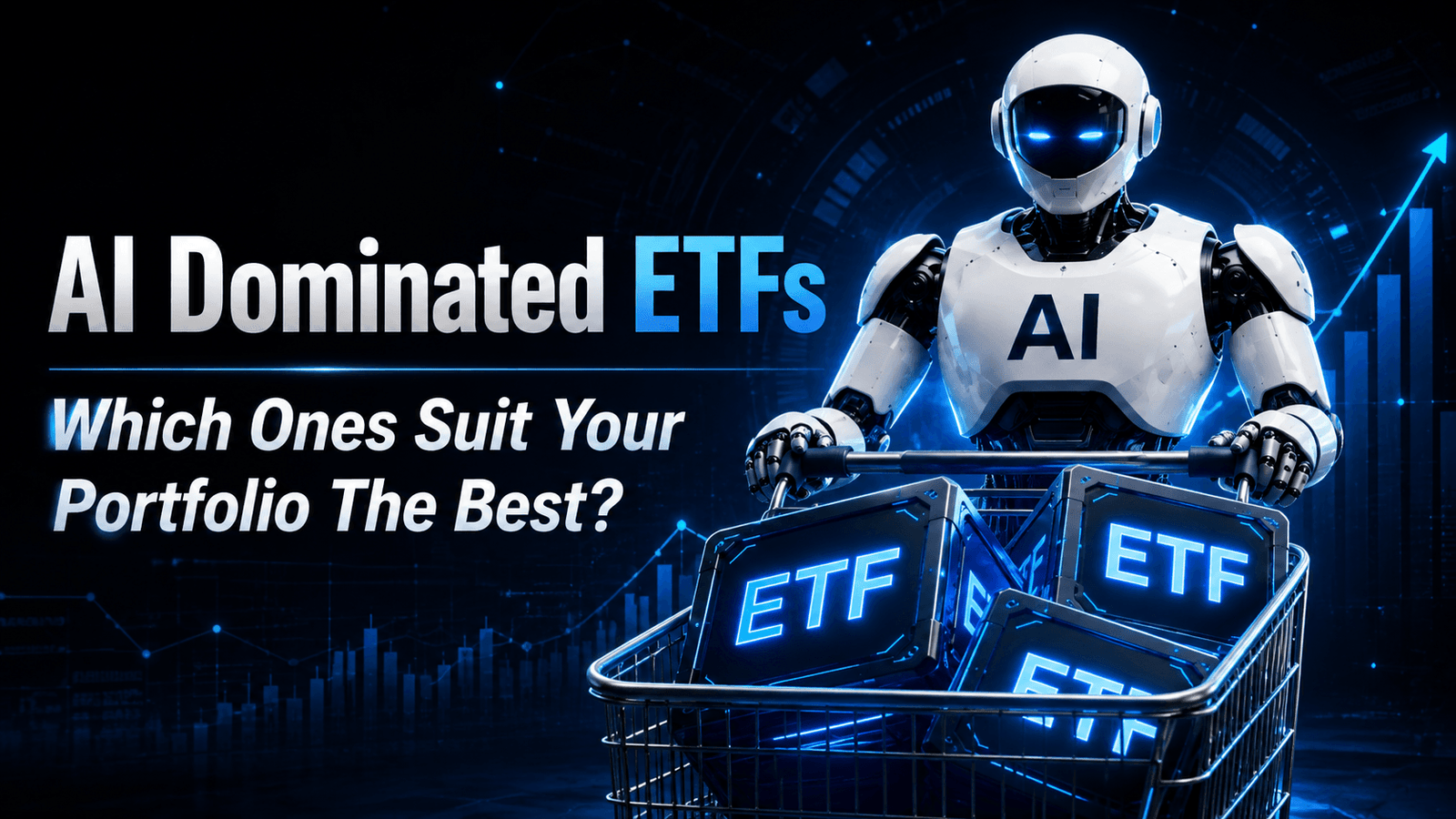
🚀 In 2026, one AI ETF gained 68.7% while another lost money — both wore the same “AI” label. If you’re hunting for the best AI ETFs to ride the artificial intelligence boom without getting burned by hype, this guide breaks down exactly which funds deserve your money and why.
Why the Best AI ETFs Debate Suddenly Matters in 2026
Every fund house wants a slice of the AI trade, so the label “AI ETF” now covers everything from Nvidia-heavy chip baskets to Japanese factory-robot funds. That is precisely why identifying the best AI ETFs has become harder, not easier, in 2026. Through July, the top-performing dedicated AI fund returned 68.7%, while another AI-branded fund actually lost 2.7% over the same stretch.
That is not a rounding error. It is a 71-percentage-point gap between two funds carrying identical marketing language. For an Indian investor deciding where to park hard-earned capital, this gap matters more than any single headline about ChatGPT or Nvidia’s earnings call, because it proves that picking an AI ETF by name alone is a losing strategy.
How the Best AI ETFs Are Actually Built
Understanding construction is the first filter for spotting the best AI ETFs. Index providers first define an “AI universe” using revenue screens, patents and business filings. They then bucket companies into enablers, infrastructure providers, software firms and robotics players, apply a weighting method — market cap, revenue-based or equal weight — and cap concentration before rebalancing quarterly or semi-annually.
This rebalancing mechanism is not unique to US ETFs. Indian benchmark indices go through the same discipline; we recently covered how the Nifty 50’s inclusion and exclusion process pushed Wipro out despite its long index history. The takeaway is identical on both sides of the Pacific: an index’s rulebook, not sentiment, decides what stays in your portfolio and what gets dropped.
The Return Gap: Why Some AI ETFs Crushed Others in 2026
Here is the data that should reshape how you shortlist the best AI ETFs for your own portfolio.
| ETF | 2026 YTD Return | 1-Year Return | Expense Ratio | Top-10 Weight |
|---|---|---|---|---|
| AIS | 68.7% | 114.8% | 0.75% | 41.3% |
| IGPT | 45.8% | 71.2% | 0.56% | 58.7% |
| CHAT | 39.0% | 63.5% | 0.75% | 37.9% |
| ARTY | 38.4% | 53.5% | 0.47% | 41.4% |
| WTAI | 33.5% | 55.7% | 0.45% | 39.1% |
| THNQ | 32.9% | 51.2% | 0.68% | ~24% |
| AIQ | 15.8% | 32.2% | 0.68% | 31.2% |
| IVES | 14.1% | 28.9% | 0.75% | 46.9% |
| ROBT | 6.8% | 10.9% | 0.65% | 18.8% |
| BOTZ | -2.7% | 5.7% | 0.68% | 59.8% |
Returns are total returns through 31 July 2026, sourced from respective fund issuer disclosures — VistaShares, iShares, WisdomTree and Global X.
Expert insight: this spread isn’t a debate about whether AI will keep growing — it clearly will. It’s a debate about which layer of the AI economy — chips, cloud, software or robots — captures investor money first. Money rotated hard into memory chips and infrastructure in 2026, and funds positioned there won, regardless of how “AI” their name sounded.
Semiconductors vs AI: The Reality Check
A sharper way to judge the best AI ETFs is to line them up against plain semiconductor funds.
| Fund | Focus | 2026 YTD | 1-Year | Expense Ratio |
|---|---|---|---|---|
| AIS | AI infrastructure | 68.7% | 114.8% | 0.75% |
| SOXX | Semiconductors | 67.8% | 111.3% | 0.35% |
| SMH | Semiconductors | 50.1% | 87.8% | 0.35% |
| QQQM | Nasdaq-100 | 12.3% | 22.4% | 0.15% |
| VOO | S&P 500 | 10.2% | 19.6% | 0.03% |
Notice that SOXX, a plain-vanilla chip ETF charging less than half of AIS’s fee, nearly matched the best-performing dedicated AI fund. That’s an uncomfortable but important truth: much of the “AI ETF magic” this year was really the semiconductor cycle wearing an AI costume. Before paying a thematic premium, ask whether the fund’s non-chip holdings are actually adding value.
The CORE Checklist to Pick the Best AI ETFs
After screening dozens of thematic funds over the years, I use a simple four-point CORE checklist to separate the best AI ETFs from marketing gimmicks:
- C — Concentration: What percentage sits in the top 10 holdings? Above 55% means you’re really buying two or three stocks.
- O — Overlap: Do you already own these names via a Nasdaq-100 or S&P 500 fund? Duplication isn’t diversification.
- R — Revenue purity: Does the company sell AI, or merely use AI while earning money elsewhere?
- E — Expense and liquidity: Is the fee justified by genuinely different exposure, and can you exit without a wide bid-ask spread?
Run every candidate through CORE before it earns a place in your watchlist of the best AI ETFs.
Top AI ETFs Compared: Holdings, Fees and Returns
| ETF | AUM | Fee | Primary Exposure | Our Verdict |
|---|---|---|---|---|
| ARTY | $3.83bn | 0.47% | Full AI stack, hardware-heavy | Best all-round passive pick |
| WTAI | $0.67bn | 0.45% | Broad, systematic AI | Best value for money |
| CHAT | $1.86bn | 0.75% | Actively managed generative AI | Best active management |
| AIS | $0.91bn | 0.75% | AI infrastructure, semiconductors | Best high-conviction satellite |
| BOTZ | $3.56bn | 0.68% | Robotics and automation | Best for physical-AI theme |
| AIQ | $10.18bn | 0.68% | Broad global AI and tech | Best liquid, broad allocation |
| ROBT | $0.78bn | 0.65% | Diversified applications | Best mega-cap diversifier |
Key-Person Risk: The Dan Ives Lesson
The Dan Ives Wedbush AI Revolution ETF (IVES) faced an unusual test in July 2026 when Dan Ives, the strategist whose name and brand anchor the fund, left Wedbush to start a new venture. Wedbush confirmed the fund would keep running without operational disruption, but the deeper question is whether the “AI Revolution” thesis stays sharp once its most recognisable face has walked out the door.
This is a governance risk pattern Indian investors know well. We saw something structurally similar play out closer to home when we analysed the Tata Sons chairman resignation and its ripple effect across group companies — leadership transitions rarely break a business overnight, but they quietly reshape strategy, culture and investor confidence over the following quarters. The same caution applies to any fund whose identity is tied to one manager or one brand.
Concentration Risk: Why Even the Best AI ETFs Can Hurt You
Concentration risk isn’t an abstract warning — it plays out in real portfolios every year. Indian investors witnessed exactly this dynamic when a single leadership shock triggered the Godrej Consumer share crash following its CEO exit in 2026. A fund that leans too heavily on a handful of stocks — however dominant those stocks look today — inherits that same fragility. This is exactly why the CORE checklist above flags concentration as the very first filter, even among the best AI ETFs.
The Real Cost of Fees Over 10 Years
A 0.30 percentage-point fee difference looks trivial on day one. On a $10,000 investment compounding at 10% annually, here’s what it costs over a decade:
| Expense Ratio | Value After 10 Years | Wealth Lost to Fees |
|---|---|---|
| 0.00% | $25,937 | $0 |
| 0.45% | $24,896 | $1,042 |
| 0.47% | $24,850 | $1,087 |
| 0.56% | $24,647 | $1,291 |
| 0.68% | $24,378 | $1,560 |
| 0.75% | $24,222 | $1,715 |
The gap between a 0.45% fund and a 0.75% fund is roughly $674 over 10 years on this illustration alone. That doesn’t mean always chase the cheapest fund — it means the pricier fund among the best AI ETFs must earn its extra fee through genuinely superior stock selection, not brand recall.
How Indian Investors Can Buy the Best AI ETFs
Since none of the funds discussed above are listed on the NSE or BSE, Indian residents access them through the RBI’s Liberalised Remittance Scheme (LRS), which permits remittances up to USD 250,000 per financial year for permitted investment purposes. Practically, this works in three steps:
- Open a US stock investing account with a SEBI-compliant platform offering LRS-based remittance.
- Remit funds under your personal LRS limit — note that TCS applies on remittances above ₹7 lakh per financial year under current rules.
- Buy the AI ETF directly on Nasdaq or NYSE just like any US-listed stock.
Gains are taxed as foreign capital assets under Indian tax law, so long-term holding periods and currency movement both affect your real, rupee-denominated return — factor that into any AI ETF investment plan before you commit capital.
If you’d rather diversify locally while this global AI theme plays out, our recent coverage of the Shiprocket IPO review 2026, the Behari Lal Engineering IPO review 2026, and our explainer on the Zepto IPO pause and its valuation gap give you a homegrown lens on where fresh capital is flowing right now.
📈 Ready to start investing? Open a free Demat & Trading account:
What This Means for Your Portfolio Going Forward
Looking ahead, I expect the dispersion among AI ETFs to widen further, not shrink, as the AI capex cycle matures and rotates between hardware, software and physical robotics phases. The best AI ETFs five years from now may not be the same funds topping the charts today — memory-chip cycles are notoriously cyclical, and today’s 68% winner can easily become tomorrow’s laggard once capacity catches up with demand.
My practical advice: treat any single AI ETF as a satellite, not your entire portfolio. Pair a broad core holding with one or two thematic satellites chosen deliberately through the CORE checklist, rebalance every six months, and always check whether your “AI exposure” is actually duplicate exposure you already own elsewhere.
FAQs on the Best AI ETFs
What are the best AI ETFs to invest in for 2026?
The best AI ETFs for 2026 depend on your goal: ARTY is the strongest all-round passive pick, WTAI is the best low-cost option, and CHAT is the top actively managed choice, while AIS and BOTZ work well as specialist satellites.
How do Indian investors buy the best AI ETFs listed in the US?
Indian investors can buy US-listed AI ETFs through the RBI’s Liberalised Remittance Scheme, which allows remittances of up to USD 250,000 per financial year through a SEBI-compliant international investing platform.
Why did some of the best AI ETFs outperform others in 2026?
The gap came from hidden factor exposure rather than the AI label. Semiconductor and AI-infrastructure heavy funds like AIS gained over 68% through July 2026, while robotics-focused BOTZ lost value in the same period.
Are the best AI ETFs risky investments?
Yes. Many AI ETFs hold 40–60% of assets in their top 10 stocks, creating concentration risk, and remain highly sensitive to the semiconductor capex cycle and valuation swings.
What is the difference between AI ETFs and semiconductor ETFs?
AI ETFs span the whole AI value chain, including software, cloud and robotics, while semiconductor ETFs like SOXX focus narrowly on chipmakers — and in 2026, SOXX nearly matched the best AI ETF’s return at less than half the fee.