N Chandrasekaran’s Exit: Decoding the Tata Sons Chairman Resignation and What It Means for Your Portfolio
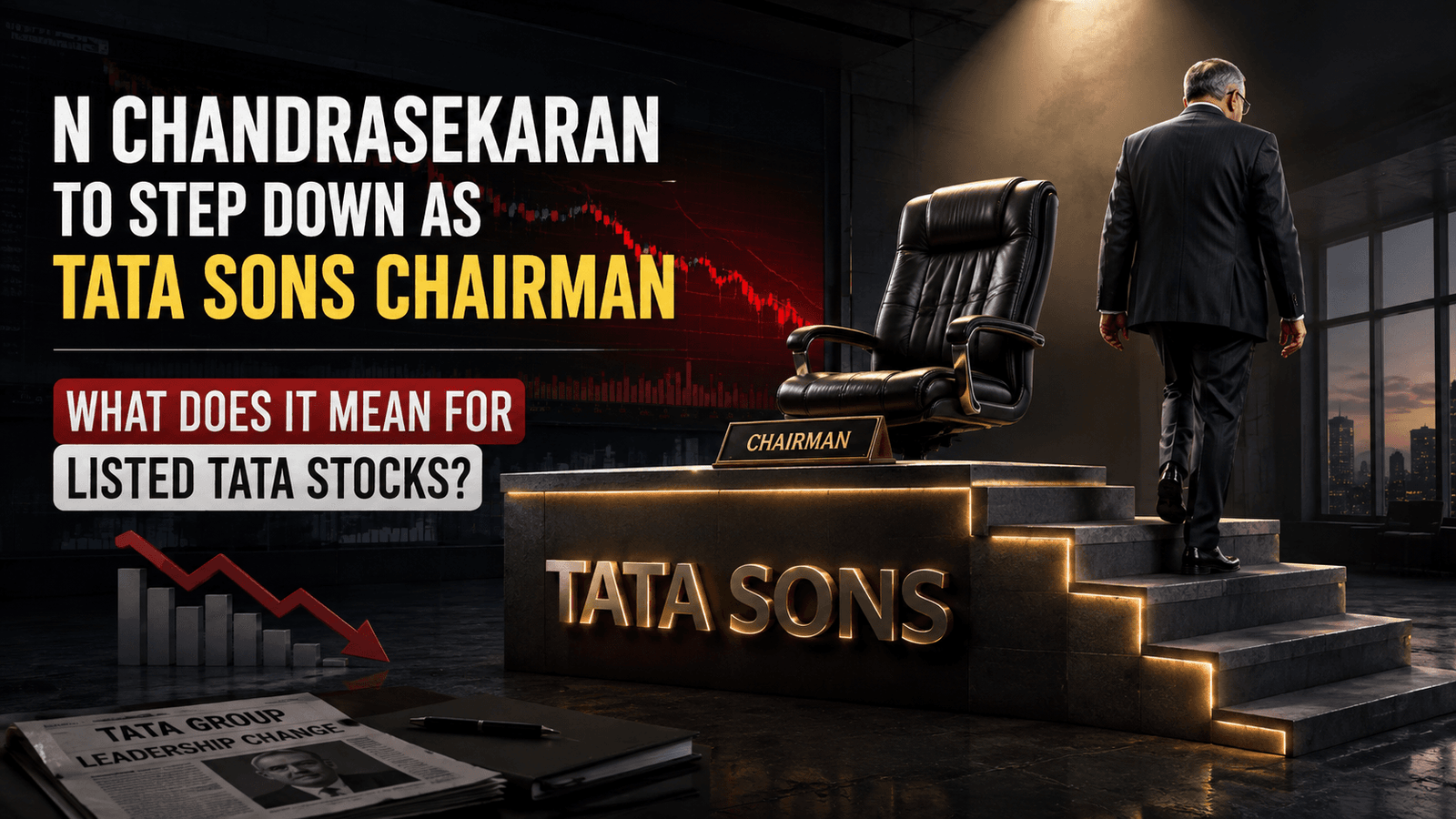
The Tata Sons chairman resignation announced on August 12, 2026 erased nearly ₹68,000 crore in market value from Tata Group stocks in a single session. If you own TCS, Tata Steel, Tata Motors or any Tata-linked stock, here is what actually changed — and what didn’t.
- Why the Tata Sons Chairman Resignation Happened
- How Tata Stocks Reacted on D-Day
- Why a Holding Company Chairman Moves Listed Stocks
- Which Tata Stocks Are Most Exposed
- Can the “One Tata” Strategy Survive?
- The Bigger Picture: A Year of Leadership Shake-ups
- Investor Playbook: What To Do Now
- Frequently Asked Questions
Why the Tata Sons Chairman Resignation Happened
Why is N Chandrasekaran stepping down as Tata Sons chairman? He is stepping down because his proposed five-year extension failed to secure unanimous board approval, and after six months of deadlock he chose to end the uncertainty himself rather than let it drag into the group’s AGM season.
Chandrasekaran has run Tata Sons since 2017. Tata Trusts, which controls roughly 66% of Tata Sons and is chaired by Noel Tata, had initially backed a fresh five-year term. But when the Nomination and Remuneration Committee brought the proposal to the board in February 2026, it did not pass unanimously — reportedly because Noel Tata pushed for a shorter, two-year term as part of a broader succession revamp, according to Hindustan Times. With no resolution reached six months later, Chandrasekaran informed the board on August 12, 2026 that he would not seek reappointment when his term ends on February 20, 2027, as confirmed in his statement carried by NDTV.
This is the crucial nuance most headlines miss: this is not an abrupt exit. Chandrasekaran remains in charge for another six months, giving the board a runway to manage succession without a leadership vacuum. But markets, as they often do, priced in the uncertainty immediately rather than waiting for clarity.
How Tata Stocks Reacted on D-Day
The Tata Sons chairman resignation triggered one of the sharpest single-day sell-offs across the Tata ecosystem in recent years. Here is how the major Tata stocks moved on August 12, 2026, based on data reported by Moneycontrol and India Today.
| Tata Company | Intraday Fall | Investor Watchpoint |
|---|---|---|
| TCS | Up to -5.95% | Group’s biggest cash generator; continuity of AI/tech strategy |
| Tata Motors PV | -4% | EV roadmap tied to Tata’s battery investments |
| Tata Steel | -1.7% to -2% | Large ongoing capex and industrial strategy |
| Tata Consumer Products | -1.5% to -2.4% | More dependent on own execution than group strategy |
| Titan | -0.57% to -2% | Operating growth mostly company-specific |
| Tata Chemicals | +0.53% | Relatively insulated from succession noise |
| Voltas | +0.98% | Business-specific demand drivers dominate |
Broader indices felt the tremor too — the Sensex slipped over 180 points and the Nifty 50 closed below 24,436 the same day, according to Times of India. Given the weight of TCS and Tata Motors in benchmark indices, any large-scale Tata stocks impact tends to spill over into the broader market. If you track index composition shifts, our detailed piece on the BSE Nifty 50 rejig and Wipro’s exit explains how heavyweight stock moves ripple through your index funds.
Why a Holding Company Chairman Moves Listed Stocks
A fair question here is: TCS, Tata Steel and Tata Power each have their own CEOs and boards, so why should a Tata Sons chairman resignation move their share prices at all? The answer lies in what Tata Sons actually is — the principal promoter and investment holding entity for the entire group, with Tata Trusts owning about 66% of it.
Tata Sons doesn’t decide how many IT deals TCS closes this quarter or how much steel Tata Steel sells. But it does control something that matters far more over a 5-10 year horizon: capital allocation, cross-group synergy, and which new-age businesses get funded. That is precisely why the market treats the Tata Sons chairman resignation as more than routine corporate news.
Which Tata Stocks Are Most Exposed
Not every Tata stock carries the same risk from this leadership transition. The real exposure depends on how much a company relies on Tata Sons’ newer strategic bets versus its own core operations.
- TCS — Chandrasekaran personally shaped its AI and digital transformation push; continuity here matters for long-term positioning.
- Tata Power — Deeply tied to Tata’s renewable energy and EV charging ecosystem, an area built under the current leadership.
- Tata Motors Passenger Vehicles — EV strategy is linked to Agratas, Tata’s battery arm, making it sensitive to any slowdown in group-level funding.
- Tata Steel — Large multi-year capex plans depend on Tata Sons’ continued financial backing and risk appetite.
- Titan and Indian Hotels — Comparatively insulated, since their growth is driven mainly by their own consumer demand and expansion plans rather than Tata Sons’ new-business bets.
This is an important distinction for portfolio construction. A blanket reaction to sell “all Tata stocks” ignores the fact that companies like Titan or Tata Consumer Products barely need Tata Sons’ new-business capital to keep growing.
Can the “One Tata” Strategy Survive Without Chandrasekaran?
One of Chandrasekaran’s biggest legacies is the “One Tata” philosophy — getting group companies to collaborate instead of operating as silos. Tata Power feeds into the EV ecosystem, Agratas is meant to supply batteries across mobility and energy storage, and TCS has already partnered with Tejas Networks on telecom equipment.
The real test after this Tata Sons chairman resignation is whether “One Tata” was a personal Chandrasekaran project or has become genuinely institutionalised. If the next chairman continues this cross-pollination, the impact on listed Tata stocks stays limited. If priorities shift toward capital discipline over expansion, expect slower rollout of new group-wide initiatives — a scenario worth tracking closely if you hold Tata Power, Tata Motors PV, or TCS.
The Bigger Picture: A Year of Leadership Shake-ups
The Tata Sons chairman resignation doesn’t exist in isolation — 2026 has been an unusually active year for boardroom and leadership changes across corporate India, and each has taught investors a similar lesson: governance uncertainty at the top can move share prices faster than quarterly earnings. We saw this earlier when Godrej Consumer’s stock cracked following its CEO exit — a scenario we broke down in detail in our Godrej Consumer share crash and CEO exit analysis.
The primary market has also been reshaped by valuation and governance concerns this year. Zepto’s decision to pause its IPO over valuation gaps, which we covered in our Zepto IPO pause explainer, shows how sensitive both public and private markets have become to leadership and pricing clarity. Meanwhile, if you’re building a diversified watchlist beyond large caps, our reviews of the Shiprocket IPO and the Behari Lal Engineering IPO offer useful contrast to how much governance stability affects valuation confidence in new listings versus established giants like Tata.
Investor Playbook: What To Do Now
What should Tata investors track after the chairman resignation? Focus on three things: the identity and background of the successor, whether Tata Sons stays committed to funding new-age businesses, and whether the “One Tata” collaboration model continues.
- Don’t panic-sell on headline noise. TCS still depends on global IT spending, Tata Steel on steel prices, and Tata Power on its own energy business — none of that changed on August 12.
- Track the succession timeline. Chandrasekaran stays until February 20, 2027; use this window to watch board statements rather than react to speculation.
- Separate core-business stocks from growth-optionality stocks. Titan and Indian Hotels are less exposed than Tata Power or Tata Motors PV.
- Watch capital allocation signals. Tata Sons posted a strong FY26 PAT of around ₹31,961 crore (up 21.8%), so funding capacity isn’t the constraint — willingness is.
- Use volatility, don’t fear it. Sharp single-day drops in fundamentally sound large-caps have historically offered better entry points for patient investors than panic exits.
📈 Trade the Tata Stocks Volatility With the Right Broker
Open a free demat and trading account to track and act on Tata Group stock movements in real time.
Open Free Account on Dhan Open Free Account on ZerodhaFrequently Asked Questions on Tata Sons Chairman Resignation
Why did N Chandrasekaran resign as Tata Sons chairman?
N Chandrasekaran decided not to seek reappointment as Tata Sons chairman after his proposed five-year extension failed to receive unanimous board support in February 2026. Six months later, with no resolution, he informed the board on August 12, 2026 that he would step down when his term ends on February 20, 2027.
How much did Tata stocks fall after the Tata Sons chairman resignation?
Tata Group companies lost close to ₹68,000 crore in combined market capitalisation on the day of the announcement. TCS fell nearly 6%, Tata Motors Passenger Vehicles dropped about 4%, and Tata Steel, Tata Consumer Products and Titan declined between 1% and 3%.
Who will be the next Tata Sons chairman?
No successor has been named yet. Chandrasekaran continues as chairman until February 20, 2027, giving the board and Tata Trusts, led by Noel Tata, time to complete a formal succession process.
Is the Tata Sons chairman resignation a reason to sell Tata stocks?
Not on its own. The resignation does not immediately alter the fundamentals of TCS, Tata Steel or Tata Power. Long-term investors should track the succession outcome and future capital allocation rather than react solely to short-term price swings.
Which Tata stocks are most exposed to this leadership change?
Tata Power, Tata Motors Passenger Vehicles and TCS carry more exposure because they are tied to the group’s newer growth bets in energy, EVs and technology, while Titan and Indian Hotels are more insulated since their growth depends mainly on their own operations.
🔔 Never Miss a Market Move
Follow Stock Mastery Zone for daily stock market analysis, IPO reviews, and trading insights.
The Tata Sons chairman resignation is a governance story first and a stock-price story second. For investors, the smarter response to any Tata Sons chairman resignation is not to chase the panic sell-off but to watch how the succession unfolds over the next six months — because that outcome, not this week’s headlines, will decide whether Tata’s next growth chapter matches the one Chandrasekaran built.
Disclaimer: This article is for educational and informational purposes only and does not constitute investment advice. Stock market investments are subject to market risks. Please consult a SEBI-registered investment advisor before making investment decisions.