India’s LPG Crisis Explained: What It Means for Your Kitchen, Your Wallet & Your Stocks
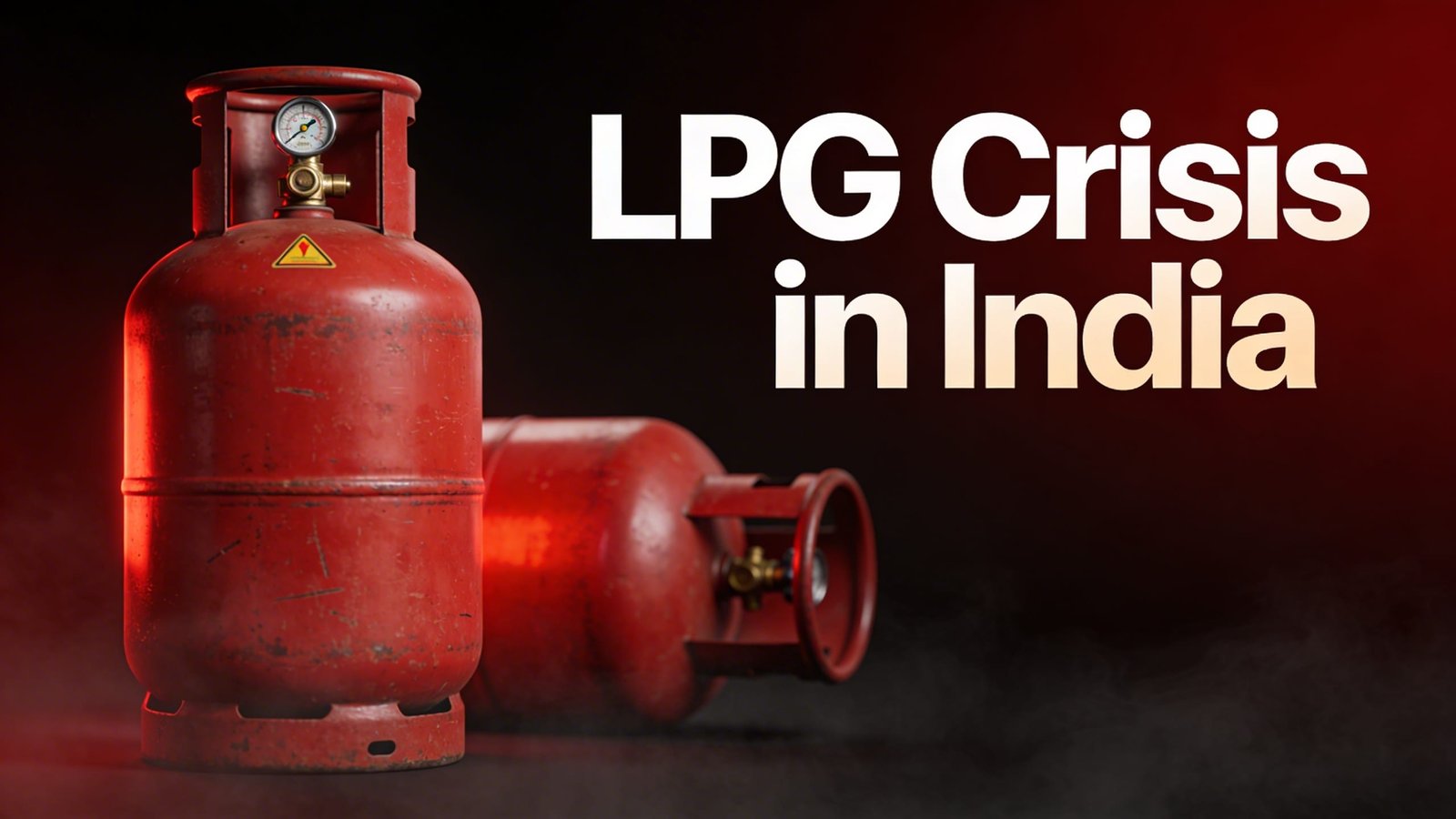
🔥 India’s LPG crisis in 2026 is not just a kitchen problem — it is a full-blown national energy emergency. With over 80% of cooking gas imported and 90% of that passing through one narrow waterway now under threat, the real question for every Indian household and investor is: how bad can this get?
🔴 What Exactly Is India’s LPG Crisis?
India’s LPG crisis of 2026 did not emerge overnight. It is the outcome of years of structural dependency on Middle Eastern energy supply — and a geopolitical shock that finally broke the fragile supply chain. When the US-Israel conflict with Iran escalated in late February 2026, shipping through the Strait of Hormuz effectively came to a halt. For India, this meant an immediate threat to its cooking gas supply.
India consumed a staggering 31.3 million metric tonnes of LPG in financial year 2024–25 but produced only around 12.8 million tonnes domestically, covering barely 40% of its own demand. The remaining 60% came from imports — and nearly all of that flowed through one chokepoint: the Strait of Hormuz. This is not just an inconvenience. This is a critical national vulnerability that has been ignored for too long.
🌊 The Strait of Hormuz: India’s Most Dangerous Dependency
The Strait of Hormuz is a 33-km wide passage between Iran and Oman. It handles close to 30% of global seaborne LPG exports. For India, it is even more critical — 90% of India’s total LPG imports pass through this waterway. When Iranian drone strikes and US retaliatory action raised the threat level in the strait to a point where major P&I insurance clubs cancelled war-risk coverage, Very Large Gas Carriers (VLGCs) simply could not sail.
Satellite data from Vortexa confirmed that Indian state-run VLGCs — including Shivalik, Nanda Devi, and Jag Vasant — were stranded and waiting away from the strait. Saudi Aramco’s Ras Tanura refinery, which supplies around 15% of India’s LPG imports, halted operations after Iranian drone debris struck the complex. The supply shock was immediate and severe.
📊 Key Numbers You Must Know
💰 LPG Price Hike 2026: What Changed and Why
On March 7, 2026, Oil Marketing Companies (OMCs) hiked the price of a 14.2 kg domestic LPG cylinder by ₹60 across all metro cities. The new price in Delhi stands at ₹913, up from ₹853. In Mumbai it is ₹912.50, in Kolkata ₹939, and in Chennai ₹928.50. Commercial LPG cylinders saw an even steeper hike of ₹115.
The government was clear: without intervention, prices would have been significantly higher. Sujata Sharma, Joint Secretary at the Ministry of Petroleum and Natural Gas, stated at a press briefing that the government absorbed a significant portion of the cost increase caused by the crisis. Even after this ₹60 hike, the retail price remains below what the global market would demand — a sign that the government is playing a difficult balancing act between consumer welfare and OMC profitability.
📚 Related Reading on Stock Mastery Zone
Beginner Stock Portfolio India: Simple 5-Stock Setup Avoid Losing Money in Stocks India: Beginner Mistakes📉 How the LPG Crisis Is Hitting OMC Stocks
The LPG crisis in India hit the stock market hard and fast. Shares of Indian Oil Corporation (IOCL), Bharat Petroleum (BPCL), and Hindustan Petroleum (HPCL) — India’s three state-run oil marketing giants — tumbled as much as 9% in a single session after international brokerage UBS downgraded all three stocks on mounting uncertainty over earnings.
UBS downgraded IOCL and BPCL to Neutral and slashed HPCL to Sell, citing that rising crude prices and the government’s policy of keeping retail prices static creates a direct earnings squeeze. The situation draws direct parallels with the 2022 oil crisis — but this time it is compounded by a weaker rupee (USD/INR now above ₹92 vs ₹79 in 2022) and direct LPG supply disruption.
Rating agencies S&P Global Ratings and Moody’s have also warned of sustained pressure on OMC profitability. The squeeze comes from all sides: higher import costs, higher freight premiums (with VLGC spot premiums at $350–400/t to April CP), a weaker rupee, and the government’s political unwillingness to allow full cost pass-through to consumers.
📋 IOCL, BPCL & HPCL: Stock Impact at a Glance
| Company | Market Cap (Approx.) | UBS Rating | Revised Target | FY27 Profit Cut | Status |
|---|---|---|---|---|---|
| IOCL (Indian Oil) | ₹2.28 Lakh Cr | Neutral | ₹175 (from ₹190) | –19% | High import exposure; refining margin support |
| BPCL (Bharat Petroleum) | ₹1.43 Lakh Cr | Neutral | ₹365 (from ₹425) | –15% | Moderate exposure; mixed outlook |
| HPCL (Hindustan Petroleum) | ₹81,600 Cr | Sell | ₹340 (from ₹540) | –46% | Highest mktg-to-refining ratio (2.2x); most at risk |
The core problem for all three OMCs: retail fuel prices in India have largely not changed since May 2022, despite massive fluctuations in global crude. The government’s LPG price hike of ₹60 offers marginal relief — the math simply does not add up at current crude prices. Analysts now prefer valuing these stocks on a price-to-book basis rather than earnings multiples, given the policy uncertainty.
Fast execution, low brokerage, great for active traders
Open Free Account →India’s most trusted platform with powerful charting tools
Open Free Account →🏛️ What the Government Has Done So Far
The government’s response to the LPG shortage in India has been multi-pronged, though industry observers note it is still reactive rather than structural. Here is what has been implemented so far:
- Essential Commodities Act invoked — Refineries ordered to maximise LPG output and restrict supply exclusively to state-run OMCs (IOCL, BPCL, HPCL)
- LPG booking gap increased — Minimum gap between cylinder bookings raised from 21 days to 25 days to curb hoarding and black marketing
- Domestic production boosted by 25% — Government redirected all incremental domestic LPG output to household consumers
- Emergency sourcing activated — In talks with the US, Australia, Canada, and UAE for emergency LPG cargoes; India signed term contracts for 2.2 million tonnes from the US in 2026
- Priority rationing system — IOCL, BPCL, HPCL formed a joint committee to prioritise supply to households, hospitals, and essential services over commercial users
- Consumer advisory issued — Government urged citizens not to panic-buy or hoard, assuring continued household supply
🏠 Who Is Hit Hardest — Households or Businesses?
The government’s triage decision has created a sharp divide: households get priority, businesses bear the brunt. Restaurants in Bengaluru, Mumbai, Chennai, and other cities reported that commercial LPG cylinders became difficult to find and extremely expensive. Hotels flagged potential closures. QSR chains, food aggregators like Swiggy and Zomato, and their listed parent companies — including Eternal (Zomato) — saw their stocks hit on supply disruption concerns.
For ordinary households, the ₹60 price hike translates to approximately ₹0.80 per day for a family of four — or just ₹0.20 per person per day. Painful, but manageable. The deeper concern, however, is what happens if the Hormuz disruption extends beyond 4–6 weeks. At 10 days of LPG stock, India would be forced into formal rationing — a scenario the government is desperately trying to avoid.
📚 More Guides You’ll Find Helpful
Price Action Trading India: One Pattern Beginners Need Stock Market for Students India: First Salary Method🔭 Future Implications: Can India Fix This Dependency?
The India LPG crisis of 2026 is ultimately a story about structural vulnerability — and the cost of ignoring it. India’s domestic LPG production has not kept pace with demand growth. Despite the government’s Pradhan Mantri Ujjwala Yojana connecting millions of new households to LPG, the production infrastructure was never scaled proportionally. The result: India’s import dependency grew from under 40% a decade ago to over 85% today.
The long-term fixes are clear but slow: diversify LPG import sources (the US, Australia, Africa), build strategic LPG reserves (India has none, unlike its crude oil reserves), and accelerate adoption of alternative cooking fuels — compressed biogas, piped natural gas, and electric induction cooking. The government has also boosted coal usage for the summer to partially offset LNG disruption in the power sector.
❓ Frequently Asked Questions
🚀 Stay Ahead of Every Market Move
Get expert analysis on LPG crisis updates, OMC stocks, energy markets and more — directly on your favourite platform. Join thousands of smart investors.
📎 Authoritative Sources
- 🏛️ Ministry of Petroleum & Natural Gas, Government of India — Official LPG supply advisories & pricing data
- 📰 The Economic Times – Energy & Oil — OMC stock analysis, UBS downgrade report
- 📰 Business Standard — State-run OMCs boost LPG production mandate
- 📰 Argus Media — India LPG stock levels & Hormuz shipping data
- 📰 BBC News — Iran conflict’s impact on India’s fuel & LPG supply
- 📰 Moneycontrol — Government press briefing on LPG price containment