🔥 LPG Crisis Impact on Eternal and Swiggy: What Every Stock Investor Must Know Right Now
- Why India Is Facing a Commercial LPG Crisis in 2026
- How Eternal and Swiggy Stocks Got Hit
- Ground Reality: Restaurants Shutting, Menus Shrinking
- What Analysts Say: Motilal Oswal, Elara & UBS
- GOV Growth Estimates: Eternal vs Swiggy
- The Hidden Victims: Gig Workers and Cloud Kitchens
- Government Response: What Is Being Done?
- Investor Playbook: Should You Buy, Hold or Exit?
- Frequently Asked Questions
⚡ Why India Is Facing a Commercial LPG Crisis in 2026
India does not produce enough LPG to meet its own demand. The country imports approximately 60–67% of its LPG requirement, and a staggering 85–90% of those imports transit through the Strait of Hormuz — the narrow waterway connecting the Persian Gulf to the Arabian Sea.
In March 2026, escalating tensions between the United States, Israel, and Iran turned that waterway into a conflict zone. Three vessels were attacked in the Strait on March 11, 2026, according to The Hindu Business Line. With shipping routes choked, India’s LPG imports — sourced primarily from Saudi Arabia and Qatar — came under severe disruption.
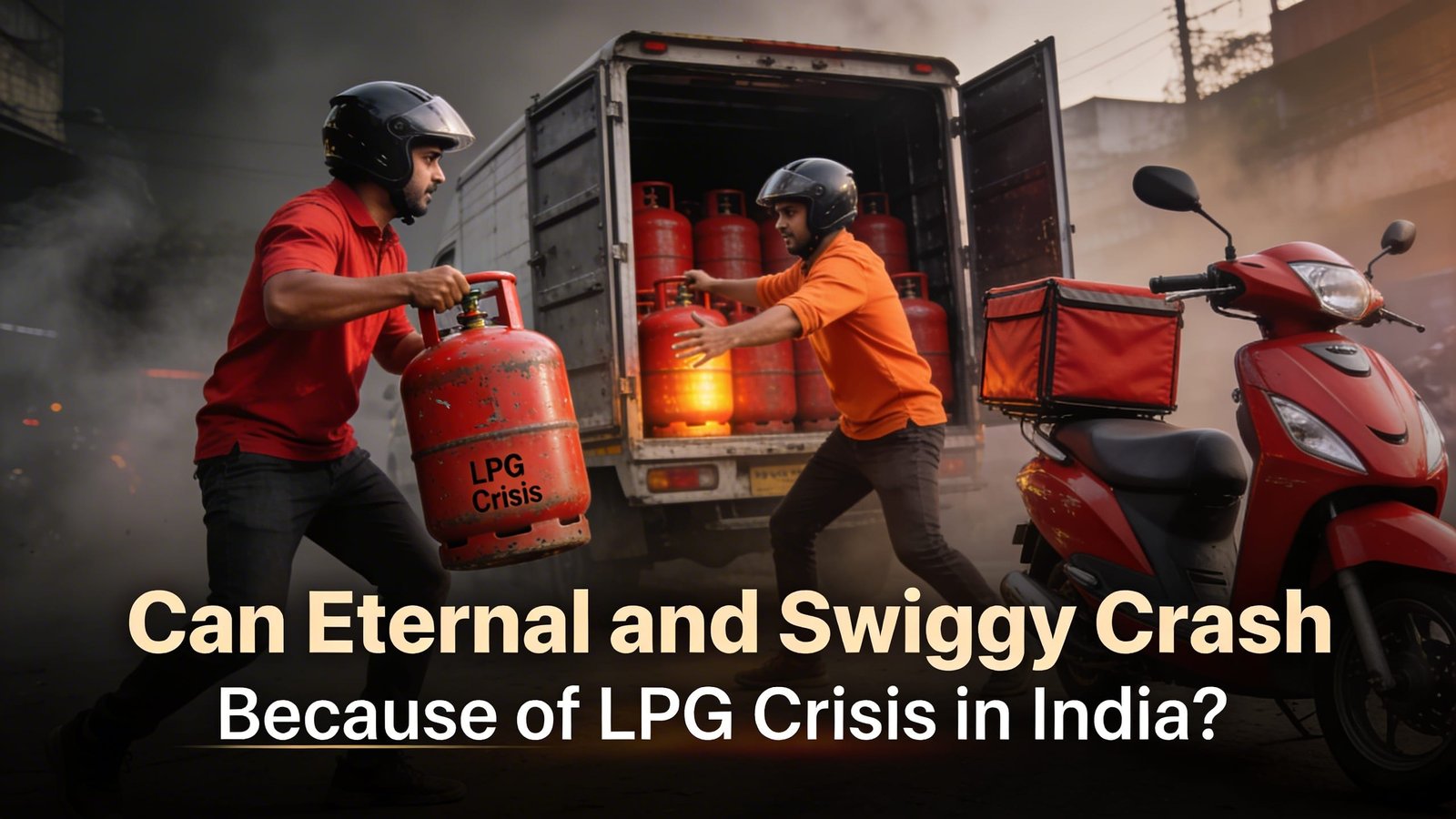
The LPG crisis impact hit commercial kitchens first, because the government prioritised household domestic supply under a March 5, 2026 directive. Restaurants, cloud kitchens, and food businesses found themselves at the back of the queue.
Want to understand the full picture of this energy crisis? Read our deep-dive: India LPG Crisis 2026: Why Your Cooking Gas Is At Risk.
📉 How Eternal and Swiggy Stocks Got Hit
The LPG crisis impact on Eternal and Swiggy was swift and severe. On BSE, shares of Eternal (Zomato’s parent company) fell to ₹222.15, a drop of 5%, before settling around ₹220.40. Swiggy shares slid to ₹271 intraday before partially recovering to the ₹282 level, as reported by News18.
Over five consecutive trading sessions in March 2026, both stocks erased nearly 8% of their market value — wiping thousands of crores in market capitalisation. The selloff was not confined to food delivery. The broader restaurant supply chain bled too: Jubilant FoodWorks (Domino’s) dropped 1.87%, Westlife Foodworld (McDonald’s) slipped marginally, and the entire QSR sector came under pressure, per Fortune India.
🍽️ Ground Reality: Restaurants Shutting, Menus Shrinking
The street-level disruption paints a grim picture. Industry bodies and restaurant associations reported that nearly 20% of hotels and restaurants in the Mumbai region were fully or partially shut due to the LPG shortage, according to Economic Times. Major cities including Bengaluru, Chennai, and Kolkata reported similar disruptions.
Pradeep Shetty, Vice-President of the Federation of Hotel & Restaurant Associations of India (FHRAI), confirmed that distributors began suspending commercial LPG supply to food businesses following the March 5 government notification, creating massive confusion in the supply chain.
- Tandoor ovens switched off at Delhi restaurants; owners shifting to induction
- Cloud kitchens reducing menus by 40–60% due to limited cooking fuel
- Some high-end restaurants halting delivery services while keeping dine-in open
- Price of induction cooktops rising due to increased demand from restaurants
- Small and mid-sized eateries most vulnerable as they cannot afford overnight infrastructure shifts
Restaurant owners told media outlets that switching from LPG to electric or induction cooking is not a quick fix — Indian commercial kitchens require high-intensity flames that induction systems simply cannot replicate at scale.
🔍 What Analysts Say: Motilal Oswal, Elara & UBS
The analyst community has been vocal about the LPG crisis impact on Eternal and Swiggy stocks, but perspectives on severity differ.
Elara Capital took a more specific stance. Senior Vice-President Karan Taurani flagged that nearly 28% of Gross Order Value (GOV) across food delivery platforms could be directly exposed to the LPG crisis, as a large chunk of orders comes from independent restaurants that are entirely dependent on gas-based cooking, per Fortune India.
However, UBS maintained a bullish outlook. The global brokerage kept a ‘Buy’ rating on Eternal with a price target of ₹375, and also assigned a Buy rating on Swiggy, viewing the LPG disruption as a near-term, temporary risk rather than a structural blow to the food delivery sector’s long-term trajectory, per CNBC TV18.
📊 GOV Growth Estimates: Eternal vs Swiggy
Before the LPG crisis, analyst projections for both companies were healthy. Here’s how the numbers stack up under current disruption scenarios:
| Metric | Eternal (Zomato) | Swiggy |
|---|---|---|
| GOV Growth Estimate FY26 | 15.3% | 20.2% |
| GOV Growth Estimate FY27 | 18.0% | 17.3% |
| Stock Fall (5 sessions) | ~8% | ~8% |
| Intraday Low (Mar 2026) | ₹222.15 | ₹271.00 |
| UBS Price Target | ₹375 (Buy) | Buy |
| GOV Exposure to LPG Risk (Elara) | ~28% of combined GOV | |
Source: Motilal Oswal Financial Services, Elara Capital, UBS — March 2026 reports
🛵 The Hidden Victims: Gig Workers and Cloud Kitchens
While stock market investors track falling share prices, the real human cost of the LPG crisis falls on gig workers. The Gig and Platform Service Workers Union stated that approximately 50–60% of food delivery orders on Zomato and Swiggy have been affected by the commercial LPG shortage, causing a direct income hit for lakhs of delivery partners across India.
The Union has urged the Ministry of Petroleum and Natural Gas to ensure 24-hour commercial LPG supply to food businesses and demanded that Zomato, Swiggy, and other platforms provide immediate ₹10,000 relief to affected gig workers. Cloud kitchens — which exist solely to fulfill delivery orders with no dine-in option — face an existential threat if the shortage persists.
- 50–60% delivery orders on Zomato/Swiggy disrupted (Gig Workers Union)
- Cloud kitchens without dine-in revenue have no fallback income source
- Gig workers facing income drops of ₹500–₹1,500 per day in affected zones
- Demand for immediate ₹10,000 relief per worker raised with platforms
🏛️ Government Response: What Is Being Done?
The Indian government has moved to contain the situation. On March 8, 2026, an order was issued directing all domestic refineries to maximise LPG production. The Ministry of Petroleum confirmed that domestic LPG output has been increased by 10%, with disbursement holding steady at around 60 lakh cylinders per day, according to News18.
Sujata Sharma, Joint Secretary, Ministry of Petroleum and Natural Gas, stated at a press briefing that the public should “not panic” and that the government has absorbed a significant part of the LPG cost increase. The current Delhi cylinder price of ₹913 (up ₹60) is subsidised — without government intervention, prices would have been considerably higher, per Hindustan Times.
A three-member committee comprising Executive Directors of IOC, HPCL, and BPCL has been formed to reprioritise LPG supply to commercial establishments based on genuine requirements. India is also exploring alternative energy supply routes, as Reuters reported.
💼 Investor Playbook: Should You Buy, Hold or Exit?
The LPG crisis impact on Eternal and Swiggy stocks is real, but the long-term story for India’s food delivery sector remains intact. Here’s how investors should think about this situation:
- Short-term risk is real: Q4 FY26 GOV numbers could disappoint if the crisis persists through March end — factor this into your expectations
- Long-term thesis unchanged: India’s food delivery penetration remains low vs global peers; structural growth drivers are intact
- UBS and Motilal Oswal both view this as temporary: Recovery post-supply normalisation is expected to be sharp
- Watch the Strait of Hormuz: Any diplomatic resolution between US, Israel, and Iran will act as a strong catalyst for both stocks
- Diversify during uncertainty: Do not concentrate positions in food delivery stocks until supply normalises
- SIP approach preferred: Systematic accumulation at lower levels may reward long-term investors once the LPG crisis passes
🚀 Start investing with zero brokerage — open your free demat account today:
❓ Frequently Asked Questions
How does the LPG crisis impact Eternal and Swiggy stocks?
The LPG crisis impact on Eternal and Swiggy works through a simple chain: LPG shortage → restaurants shut or reduce menus → fewer orders on delivery apps → lower Gross Order Value (GOV) → reduced revenue growth → stock price falls. Both stocks fell nearly 8% over 5 trading sessions in March 2026.
Why is there a commercial LPG shortage in India in 2026?
India imports 60% of its LPG, with 85–90% transiting through the Strait of Hormuz. The Iran-US-Israel conflict disrupted shipping through this route in March 2026. Three vessels were attacked on March 11, tightening supply further. The government prioritised household LPG, leaving commercial kitchens under-served.
What percentage of food delivery orders are affected by the LPG shortage?
According to the Gig and Platform Service Workers Union, approximately 50–60% of food delivery orders on Zomato and Swiggy have been disrupted. Elara Capital estimates 28% of combined GOV is exposed to LPG-dependent independent restaurants.
Should investors buy Eternal or Swiggy stock during the LPG crisis?
UBS maintains a ‘Buy’ on Eternal (target ₹375) and Swiggy, viewing the disruption as temporary. Motilal Oswal also calls it a “near-term hiccup.” For long-term investors, systematic accumulation at dips could be rewarding — but wait for clearer signals that LPG supply has stabilised before adding heavily.
What is the Indian government doing about the LPG crisis?
India boosted domestic LPG production by 10% and is maintaining 60 lakh cylinder disbursements per day. The Ministry of Petroleum formed a committee (IOC, HPCL, BPCL executives) to reprioritise commercial supply. India is also sourcing LPG through alternative routes beyond the Strait of Hormuz.
How long will the LPG crisis impact Eternal and Swiggy last?
Analysts say the impact is temporary — contingent on the Strait of Hormuz situation. If diplomatic talks progress and shipping resumes, supply could normalise within 15–20 days of maritime transit resuming. A prolonged crisis past March 2026 would, however, begin to show in Q4 FY26 earnings results for both companies.
📰 Authoritative Sources Used
- Business Standard — Motilal Oswal LPG Impact Report
- Economic Times — Eternal, Swiggy Shares Fall 4%
- Fortune India — LPG Shortage Fears Hit Food Delivery Stocks
- Economic Times — LPG Shortage Shuts Mumbai Restaurants
- Hindustan Times — 90% of India’s LPG Imports via Hormuz
- Reuters — India Eyes Alternative Energy Supplies
- CNBC TV18 — UBS Buy on Eternal and Swiggy
- Inc42 — Looming LPG Crisis Threatens Q4 for Zomato, Swiggy