The stock market is one of the most widely discussed ways to participate in the growth of businesses and build long-term wealth. However, for someone who is completely new to investing, understanding how the share market works can feel confusing.
You may have heard terms such as shares, stock exchanges, Demat accounts, Nifty 50, Sensex, dividends and market capitalisation. But what do these terms actually mean? How do people buy and sell shares? And how can a beginner start learning about the stock market?
The good news is that you don’t need advanced financial knowledge to understand the basics. By learning a few important concepts step by step, you can develop a solid foundation for making informed financial decisions.
This stock market for beginners guide explains the fundamentals of the share market, with a primary focus on India and examples that are useful to readers worldwide.
Whether you are a student, working professional, first-time investor or someone who simply wants to understand the financial markets, this guide will help you learn how the stock market works.
What You’ll Learn in This Guide
- What the stock market is and how it works.
- What shares are and why companies issue them.
- How buyers and sellers trade shares.
- The difference between NSE and BSE.
- What Nifty 50 and Sensex represent.
- The difference between primary and secondary markets.
- How to start investing in the Indian stock market.
- What Demat and trading accounts are.
- Important stock market terms every beginner should understand.
- How investing differs from trading.
- Common mistakes and risks beginners should avoid.
Important Note
Stock market investments are subject to market risks. Share prices can rise or fall, and investors may lose part or all of their invested capital. This article is intended for educational purposes and does not provide personalised investment advice or guarantee returns. Learn the fundamentals and understand the risks before making investment decisions.
Table of Contents
1. What Is the Stock Market?
The stock market is a marketplace where investors can buy and sell shares of publicly listed companies.
When a company issues shares, it offers investors an opportunity to purchase a portion of its ownership. People who buy these shares become shareholders and may benefit if the business grows in value. However, they also bear the risk of losing money if the company’s performance or market valuation declines.
In simple words, the stock market connects companies that want to raise capital with investors who want to participate in business ownership.
For example, imagine a company has issued 1,00,000 equal equity shares. If you own 1,000 of those shares, you hold 1% of its equity ownership, assuming all shares carry equal ownership rights.
This is the basic principle behind stock market investing.
1.1 What Is a Share?
A share is a unit of ownership in a company.
When you purchase equity shares of a listed company, you become one of its shareholders. Depending on the class of shares and applicable company rules, you may have certain rights, such as voting rights and eligibility to receive dividends when declared.
For example:
Suppose you purchase 10 shares of a company at ₹200 per share.
Your initial investment is:
10 × ₹200 = ₹2,000
Now imagine the share price increases to ₹250.
The market value of your investment becomes:
10 × ₹250 = ₹2,500
Your unrealised gain is ₹500, excluding applicable charges and taxes.
However, if the share price falls to ₹150, the investment value becomes ₹1,500, resulting in an unrealised loss of ₹500.
This simple example shows why stock market investments can generate returns but also involve risk.
1.2 Why Do Companies Issue Shares?
Companies need capital to operate, expand and develop their businesses. They can raise funds through different methods, including borrowing money and issuing shares.
Some common reasons companies issue shares include:
- Expanding business operations.
- Establishing new factories or offices.
- Developing new products and services.
- Funding research and development.
- Reducing certain financial obligations.
- Supporting long-term growth plans.
When a company issues new shares, it can raise equity capital from investors without taking on the same repayment obligations as a conventional loan. However, existing ownership percentages may be diluted.
1.3 Why Do Investors Buy Shares?
Investors purchase shares for different financial objectives.
Common reasons include:
Capital appreciation: Investors may purchase shares because they believe the company’s value could increase over time.
Dividends: Some companies distribute a portion of their profits to eligible shareholders. Dividends are not guaranteed.
Ownership: Equity shareholders own a portion of the company and may have rights associated with their shares.
Portfolio diversification: Shares can form part of a diversified investment portfolio alongside other asset classes.
Important Insights
- A share represents ownership in a company, not simply a number displayed on a trading application.
- Companies may issue shares to raise capital for business activities.
- Investors can benefit from capital appreciation and dividends, but neither is guaranteed.
- A company’s share price can decline even when the business continues operating.
2. How Does the Stock Market Work?
The stock market operates through a system that connects buyers and sellers through recognised stock exchanges.
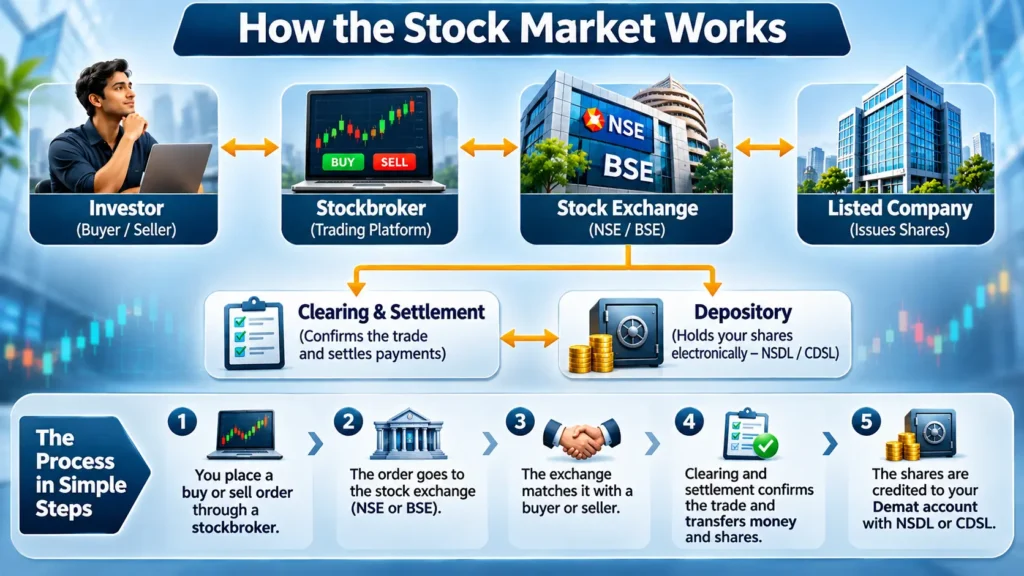
When someone wants to purchase shares, they generally place a buy order through a stockbroker. The broker routes the order to the relevant exchange. The exchange’s trading system matches compatible buy and sell orders according to its rules.
Let’s understand the process with a simple example.
Suppose you want to buy 10 shares of a listed company.
- You log in to your broker’s trading platform.
- You select the company and enter the quantity.
- You choose an appropriate order type and submit the buy order.
- Your order reaches the stock exchange through the broker.
- If a compatible selling order is available, the exchange matches the orders.
- After execution, the trade enters the clearing and settlement process.
- Securities and funds are transferred according to the applicable settlement arrangements.
The exact execution price and timing depend on market conditions, order type, available liquidity and exchange rules.
2.1 Who Are the Main Participants in the Stock Market?
Several participants work together to make stock market transactions possible.
| Participant | Role |
|---|---|
| Investors | Buy and sell securities to meet financial objectives |
| Listed companies | Issue shares and provide ownership opportunities |
| Stock exchanges | Provide electronic platforms for securities trading |
| Stockbrokers | Give clients access to stock exchanges |
| Depositories | Maintain securities in electronic form |
| Depository Participants | Provide investors access to depository services |
| Clearing corporations | Handle clearing and settlement obligations |
| Regulators | Establish rules and supervise market participants |
2.2 How Are Stock Market Transactions Completed?
Buying and selling shares involves more than matching orders.
After a trade is executed, the clearing and settlement process determines the obligations of the parties involved and facilitates the transfer of funds and securities.
In India’s equity market, the standard rolling settlement cycle for the normal segment is generally T+1, where T represents the trading day. An optional T+0 settlement mechanism is also available for eligible securities and participants under applicable arrangements.
For example, in a normal T+1 settlement, a trade executed on a trading day is generally settled on the next working day, excluding applicable holidays.
External reference: NSE – Equity Market Settlement Cycle
3. What Are the Different Types of Stock Markets?
The term stock market is often used broadly, but the market can be understood through different categories based on how securities are issued and traded.
3.1 Primary Market
The primary market is where companies and other eligible issuers offer new securities to investors.
An Initial Public Offering (IPO) is a common example. When a company launches an IPO, it offers shares to the public according to its offer documents and applicable regulations.
The company receives the proceeds from the issue, subject to the offer structure and applicable expenses.
3.2 Secondary Market
The secondary market is where investors buy and sell securities that have already been issued.
For example, after a company’s shares are listed on NSE or BSE, investors can trade those shares with other market participants.
In an ordinary secondary-market transaction, the seller receives the sale proceeds rather than the company issuing the shares.
3.3 Equity Market
The equity market is where company ownership securities, such as equity shares, are issued and traded.
Investors purchase equity shares to participate in the ownership and potential growth of businesses.
3.4 Debt Market
The debt market involves securities such as government and corporate bonds.
Unlike equity shares, debt securities generally represent borrowing obligations. Investors may receive interest payments according to the terms of the security, although debt investments also carry risks.
Primary Market vs Secondary Market
Feature Primary Market Secondary Market Main purpose Issue new securities Trade existing securities Main participants Issuers and investors Buyers and sellers Example Initial Public Offering Buying listed shares Who receives the proceeds? Issuer, subject to issue arrangements Selling investor Price determination Issue pricing and applicable process Market demand and supply
4. Stock Market in India: NSE, BSE, Nifty and Sensex
India has two major stock exchanges: the National Stock Exchange (NSE) and the Bombay Stock Exchange (BSE).
Both provide electronic trading platforms for securities. Understanding these exchanges and their benchmark indices is important for anyone learning about the Indian share market.
4.1 What Is NSE?
The National Stock Exchange of India, commonly called NSE, is one of India’s major stock exchanges.
It provides an electronic platform where investors and market participants can trade eligible securities through registered intermediaries.
NSE is also associated with the Nifty family of indices, including the widely followed Nifty 50.
Official website: https://www.nseindia.com/
4.2 What Is BSE?
The Bombay Stock Exchange, commonly called BSE, is another major stock exchange in India.
Established in 1875, BSE provides a regulated marketplace for trading listed securities. It is also associated with the Sensex, one of India’s best-known benchmark indices.
Official website: https://www.bseindia.com/
4.3 NSE vs BSE: What Is the Difference?
Although NSE and BSE perform similar core functions, they are separate stock exchanges with their own systems, listing arrangements and benchmark indices.
| Feature | NSE | BSE |
|---|---|---|
| Full name | National Stock Exchange | Bombay Stock Exchange |
| Established | 1992 | 1875 |
| Popular benchmark index | Nifty 50 | Sensex |
| Trading system | Electronic | Electronic |
| Main function | Securities trading | Securities trading |
A company may be listed on one or both exchanges, depending on its listing arrangements.
4.4 What Is Nifty 50?
Nifty 50 is a benchmark index representing 50 selected companies listed on NSE, according to the index’s methodology.
It is designed to represent a broad segment of India’s large-cap equity market. Investors and financial analysts often use it as a benchmark for evaluating market performance.
When Nifty 50 rises, the index value has increased. When it falls, the index value has declined.
However, the movement of Nifty 50 does not mean every individual stock in India has moved in the same direction.
Official reference: Nifty Indices – Nifty 50
4.5 What Is Sensex?
Sensex is the benchmark index associated with BSE. It tracks 30 selected companies according to its index methodology.
It is commonly used to understand the performance of a segment of India’s equity market.
The companies included in the index may change over time according to the applicable methodology and review process.
4.6 What Is a Stock Market Index?
A stock market index measures the performance of a selected group of securities.
An index can represent a broad market, a particular sector, a company-size category or another defined segment.
Examples include:
- Nifty 50
- BSE Sensex
- Nifty Bank
- Nifty Midcap indices
Investors use indices to understand market movements and compare investment performance.
4.7 What Is SEBI?
The Securities and Exchange Board of India (SEBI) is the regulator of India’s securities market.
Its responsibilities include investor protection, regulation of securities markets and promoting their development.
For beginners, understanding SEBI’s role is important because investors should use registered intermediaries and be cautious of unverified investment offers.
Official website: https://www.sebi.gov.in/
Important Insight
Nifty 50 and Sensex are market indices, not individual stocks. You cannot purchase an index directly in the same way you purchase a company’s share. However, investment products such as index mutual funds and exchange-traded funds may provide exposure to an index, subject to their structure and risks.
5. Types of Shares and Stocks
Different shares and stocks have different ownership rights, characteristics and risk profiles.
Understanding these categories can help beginners interpret company information and compare investment opportunities.
5.1 Equity Shares
Equity shares represent ownership in a company.
Equity shareholders generally have voting rights, subject to the rights attached to the share class and applicable company rules.
Their returns may come from capital appreciation and dividends, but they also bear the risk of changes in the company’s value.
5.2 Preference Shares
Preference shares generally provide preferential rights regarding dividend payments and repayment of capital during liquidation, according to their terms.
Their features can vary. Some preference shares may be cumulative, convertible or redeemable, depending on the issue terms.
5.3 Large-Cap Stocks
Large-cap stocks represent companies with relatively large market capitalisations.
These businesses may have established operations, significant market presence and broader investor participation.
However, a large market capitalisation does not make a stock risk-free.
5.4 Mid-Cap Stocks
Mid-cap stocks represent companies with medium-sized market capitalisations.
They may offer growth opportunities but can also experience greater volatility and business risks.
5.5 Small-Cap Stocks
Small-cap stocks represent companies with comparatively smaller market capitalisations.
Some may have significant growth potential, but they can also carry higher liquidity, volatility and business risks.
5.6 Growth, Value and Dividend Stocks
These are common investment classifications:
- Growth stocks: Companies investors expect to grow faster than the broader market or their industry.
- Value stocks: Companies whose shares appear undervalued relative to selected financial or valuation measures.
- Dividend stocks: Companies that have a history of distributing dividends, although future distributions are not guaranteed.
A company can belong to more than one of these categories.
6. How to Start Investing in the Stock Market in India
Understanding how to start investing in the share market is one of the most common questions beginners have.
For an individual buying and holding listed Indian equity shares electronically, a bank account, trading account and Demat account are generally required.
According to SEBI’s investor education material:
- A Demat account is used to hold securities electronically.
- A trading account is used to buy and sell securities through a registered stockbroker.
- A bank account is used to transfer and receive funds.
6.1 Step 1: Understand the Basics Before Investing
Before opening an account or purchasing shares, learn:
- What shares represent.
- How stock exchanges operate.
- How share prices change.
- What market risk means.
- How to research a company.
- How investing differs from trading.
Understanding these concepts can help you avoid decisions based entirely on speculation or market rumours.
6.2 Step 2: Open a Demat Account
A Demat account holds securities in electronic form.
In India, investors generally open a Demat account through a SEBI-registered Depository Participant associated with a recognised depository.
The two recognised depositories in India are NSDL and CDSL.
Read our detailed guide: What Is a Demat Account?
6.3 Step 3: Open a Trading Account
A trading account allows you to place buy and sell orders through a stockbroker.
Before choosing a broker, examine its registration, services, charges, platform features and customer support.
6.4 Step 4: Complete KYC Verification
KYC means Know Your Customer.
Investors must complete the applicable identity and verification requirements when opening accounts with financial intermediaries.
Follow the official account-opening procedure and review all documents carefully.
6.5 Step 5: Choose a Registered Stockbroker
Consider the following factors before choosing a broker:
- Regulatory registration.
- Brokerage charges.
- Account maintenance charges.
- Platform reliability.
- Customer support.
- Security and authentication features.
- Available services.
- Terms and conditions.
Don’t choose a broker only because of an attractive promotion or advertisement.
6.6 Step 6: Understand How to Place a Stock Order
Once your account is active and funded, you can learn how orders work.
Common order types include:
- Market orders.
- Limit orders.
- Stop-loss orders.
A market order generally seeks execution at the best available prices, while a limit order specifies a price limit. Execution is not guaranteed for every order.
6.7 Step 7: Research Before Purchasing Shares
Before buying shares, understand the company’s business, financial performance, debt, cash flow, management and valuation.
Never purchase a stock simply because its price has increased recently or someone claims it will deliver unusually high returns.
💡
Pro Tip
- Learn the difference between investing and trading before opening positions.
- Verify that your stockbroker and intermediary are registered.
- Understand all account and transaction charges.
- Never share your trading password, OTP or other confidential credentials.
- Read company disclosures instead of relying only on social media opinions.
- Start by learning about risk and diversification, not by searching for quick profits.
7. How to Choose Stocks as a Beginner
Choosing stocks requires more than looking at a company’s share price or recent performance.
A sensible research process begins with understanding the underlying business.
7.1 Understand the Company’s Business
Start by asking:
- What products or services does the company offer?
- Who are its customers?
- How does it generate revenue?
- What makes it competitive?
- Which risks could affect its business?
If you cannot explain how a company makes money, spend more time researching it before considering an investment.
7.2 Examine Revenue and Profitability
Revenue indicates the money a company earns from its business activities.
Profitability measures help investors understand how much of that revenue remains after expenses.
Review financial performance across multiple reporting periods instead of relying on one quarter.
7.3 Understand Debt and Cash Flow
Debt can create financial pressure, particularly when a company struggles to meet its financial obligations.
Operating cash flow provides information about the cash generated by a company’s normal business operations.
7.4 Understand Valuation
A good company is not automatically a good investment at every price.
Investors commonly examine valuation measures such as:
- Price-to-Earnings ratio (P/E).
- Price-to-Book ratio (P/B).
- Earnings per Share (EPS).
- Return on Equity (ROE).
- Enterprise Value to EBITDA (EV/EBITDA).
These metrics should be interpreted in the context of the company’s industry, business model, financial performance and growth prospects.
7.5 Diversify Your Investments
Putting all your money into one company can expose your portfolio to significant company-specific risk.
Diversification involves spreading investments across different companies, industries or asset classes.
It can help reduce concentration risk, although it cannot eliminate market risk or guarantee positive returns.
Important Insights: What Beginners Should Remember
- A low share price does not automatically mean a stock is undervalued.
- A profitable company can still be overpriced.
- Revenue growth should be considered alongside profitability and cash flow.
- Debt levels and management quality can affect business performance.
- Diversification helps manage concentration risk but does not remove all investment risks.
8. Important Stock Market Terms Every Beginner Should Know
Understanding common stock market terminology makes financial news, company reports and investing discussions easier to follow.
| Stock market term | Meaning |
|---|---|
| Share | A unit of ownership in a company |
| Stock exchange | A marketplace for trading securities |
| Market capitalisation | Market value of a company’s outstanding shares |
| Bull market | A market environment characterised by rising prices |
| Bear market | A market environment characterised by falling prices |
| Dividend | A distribution made to eligible shareholders |
| IPO | Initial Public Offering |
| Trading volume | Number of shares or contracts traded during a period |
| Liquidity | How easily an asset can be bought or sold without significantly affecting its price |
| Bid price | Price a buyer is willing to pay |
| Ask price | Price a seller is willing to accept |
| P/E ratio | Share price relative to earnings per share |
| Face value | Nominal value assigned to a share |
| 52-week high | Highest recorded trading price during the preceding 52 weeks |
| 52-week low | Lowest recorded trading price during the preceding 52 weeks |
| Portfolio | Collection of investments held by an investor |
| Volatility | Degree of price fluctuation over a period |
Beginners should learn these terms gradually and understand how they apply in real market situations.
9. Investing vs Trading: What Is the Difference?
Investing and trading are two different approaches to participating in the stock market.
Although both involve buying and selling securities, they often differ in objectives, time horizons, research methods and risks.
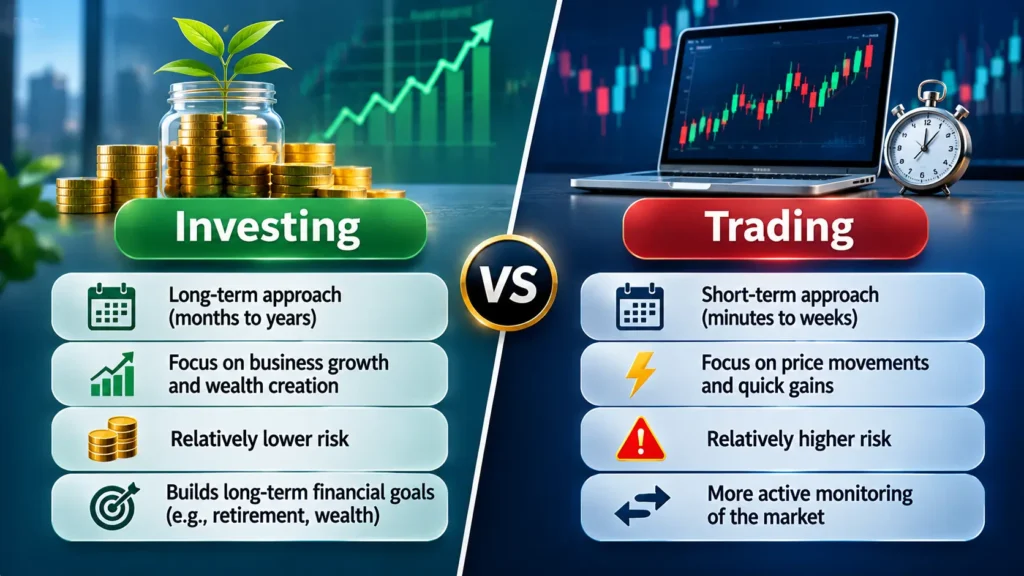
9.1 What Is Stock Market Investing?
Investing generally involves purchasing securities with a longer-term objective.
Investors may study a company’s business, financial statements, competitive position and long-term prospects before deciding whether to hold its shares.
9.2 What Is Stock Market Trading?
Trading generally involves buying and selling securities over shorter periods to benefit from price movements.
Trading approaches include intraday trading and swing trading.
9.3 Difference Between Investing and Trading
| Feature | Investing | Trading |
|---|---|---|
| Typical time horizon | Longer term | Shorter term |
| Main focus | Business performance and long-term value | Price movements |
| Research | Fundamentals and valuation | Price, volume and market behaviour |
| Activity | Often less frequent | Can be frequent |
| Costs | Depend on transactions and holding | Can increase with frequent transactions |
| Risks | Market and company risks | Market, execution and trading risks |
Neither approach guarantees profits.
Beginners should understand the costs, risks, time commitment and their own financial circumstances before deciding how to participate.
Related reading: Types of Trading in the Stock Market
10. What Factors Affect Stock Prices?
Stock prices change because of the interaction between buyers and sellers. Their decisions are influenced by company performance, economic conditions, industry developments and investor expectations.
Some important factors include:
10.1 Company Financial Performance
Revenue, profits, margins, debt and cash flow can influence how investors value a company.
Strong financial performance may improve investor expectations, while disappointing results may lead to selling pressure.
10.2 Demand and Supply
When buyers are willing to pay higher prices and available selling supply is limited, the share price may rise.
When more investors want to sell than buyers are willing to purchase at current prices, the share price may fall.
10.3 Economic Conditions
Interest rates, inflation, economic growth and employment conditions can influence companies and investor sentiment.
For example, higher borrowing costs may affect businesses that depend heavily on debt.
10.4 Government Policies and Regulations
Changes in taxation, trade policies, industry regulations and government spending can affect companies differently.
10.5 Global Events
International economic developments, commodity prices, geopolitical events and currency movements may influence the Indian stock market.
10.6 Investor Sentiment
Investor expectations and emotions can influence short-term price movements.
Fear, optimism, uncertainty and market speculation can sometimes cause prices to move beyond what company fundamentals alone might suggest.
11. Common Stock Market Mistakes Beginners Should Avoid
Learning what not to do is just as important as learning how the share market works.
Here are some common mistakes beginners should understand.
11.1 Investing Without Research
Buying a stock without understanding the company’s business and financial position can expose you to unnecessary risk.
11.2 Following Rumours and Unverified Tips
Social media posts and messaging groups may contain misleading or incomplete information.
Verify important claims through official company announcements and reliable financial sources.
11.3 Investing Money Needed for Essential Expenses
Equity prices can fall significantly.
Avoid exposing money needed for essential expenses or near-term financial commitments to stock market risk.
11.4 Putting All Your Money Into One Stock
Concentrated investments can expose your portfolio to the performance of a single company.
Diversification can help manage this risk.
11.5 Confusing a Low Share Price With a Cheap Stock
A stock trading at ₹20 is not automatically cheaper in valuation terms than a stock trading at ₹2,000.
Investors must consider earnings, market capitalisation, outstanding shares and valuation.
11.6 Trading Without Understanding the Risks
Frequent trading may involve brokerage, taxes, market risk and execution challenges.
Understand the risks and costs before placing orders.
11.7 Expecting Guaranteed Returns
No genuine equity investment can guarantee a particular return.
Be cautious of anyone promising fixed or unusually high profits from stock market investing or trading.
💡
Pro Tip
- Research a company’s business before considering its shares.
- Never make investment decisions only because a stock is trending.
- Avoid borrowing money to speculate in the stock market.
- Understand the difference between short-term price movements and long-term business performance.
- Keep your financial goals and risk tolerance in mind.
- Verify investment information through reliable sources.
12. How Much Money Do You Need to Start Investing?
There is no single minimum investment amount that applies to every listed stock.
The amount required depends on the share price, the quantity purchased and applicable transaction charges.
For example:
Suppose a share is trading at ₹100 and you purchase five shares.
Your basic purchase value is:
5 × ₹100 = ₹500
Your actual transaction cost may also include applicable brokerage, taxes, exchange charges and other fees.
Some stocks may have much higher prices, while others may trade at lower prices. Therefore, the required investment varies.
A beginner should not focus only on starting with a small amount. It is more important to understand the investment, its risks and whether the money is suitable for equity exposure.
13. A Step-by-Step Learning Roadmap for Stock Market Beginners
If you are completely new to investing, follow a structured learning process instead of trying to understand every topic at once.
Step 1: Understand Stock Market Fundamentals
Learn what shares are, how stock exchanges work and why stock prices change.
Step 2: Learn About the Indian Stock Market
Understand NSE, BSE, Nifty 50, Sensex and SEBI’s role in regulating the securities market.
Step 3: Understand Investment Accounts
Learn how bank accounts, trading accounts and Demat accounts work together.
Step 4: Study Company Fundamentals
Understand revenue, profits, debt, cash flow, valuation and business models.
Step 5: Learn About Investment Risks
Understand market risk, company-specific risk, volatility, liquidity and diversification.
Step 6: Practise Research Before Making Decisions
Read company annual reports, official announcements and reliable educational materials.
Step 7: Continue Improving Your Knowledge
Financial markets evolve. Keep learning about new products, regulations, market developments and investment concepts.
There is no need to rush into buying shares. Building financial knowledge is an ongoing process.
Important Note: Opening a Demat account or trading account does not mean you are ready to invest. First understand the products you are considering, their risks, applicable charges and your financial objectives.
Frequently Asked Questions (FAQs)
What is the stock market in simple words?
The stock market is a marketplace where investors buy and sell shares of publicly listed companies. Buying equity shares makes an investor a part-owner of the company, subject to the rights attached to those shares.
How much money is needed to start investing in stocks in India?
There is no universal minimum amount for buying listed shares. The amount depends on the share price, quantity purchased and applicable transaction charges.
How can a beginner learn the stock market?
Start by understanding shares, stock exchanges, market indices, Demat accounts, company financial statements and investment risks. Learn each concept gradually through reliable educational resources.
Is the stock market risky for beginners?
Yes. Stock prices can rise or fall, and investors can lose some or all of their invested capital. Understanding risk, researching companies and diversifying investments are important.
What is the difference between NSE and BSE?
NSE and BSE are India’s two major stock exchanges. Both provide platforms for securities trading. Nifty 50 is a major NSE benchmark index, while Sensex is a major BSE benchmark index.
What is the difference between a Demat account and a trading account?
A Demat account holds securities electronically, while a trading account is used to place buy and sell orders through a stockbroker.
Can I invest in shares without a Demat account?
For ordinary retail investors buying and holding listed Indian equity shares electronically, a Demat account is generally required. Different investment products and transaction arrangements may have different requirements.
Is investing the same as trading?
No. Investing generally focuses on longer-term ownership and business performance, whereas trading usually focuses on shorter-term price movements.
What are Nifty 50 and Sensex?
Nifty 50 and Sensex are benchmark Indian stock market indices. They track selected companies and are commonly used to understand the performance of parts of the Indian equity market.
What is the role of SEBI in the Indian stock market?
SEBI is India’s securities market regulator. Its responsibilities include investor protection, regulation of securities markets and promoting their development.
What is the difference between the primary and secondary markets?
The primary market is where new securities are issued to investors, while the secondary market is where previously issued securities are traded between investors.
15. Key Takeaways: Stock Market for Beginners
Key Takeaways
- The stock market is a marketplace where investors buy and sell shares of listed companies.
- A share represents a unit of ownership in a company.
- Companies may issue shares to raise capital for business activities.
- Investors may benefit from capital appreciation and dividends, but returns are not guaranteed.
- NSE and BSE are India’s two major stock exchanges.
- Nifty 50 and Sensex are benchmark indices that track selected companies.
- A Demat account holds securities electronically, while a trading account facilitates buying and selling.
- Company research, valuation and diversification are important investing concepts.
- Investing and trading have different objectives, time horizons and risks.
- Understanding risk should come before making investment decisions.
- Confirm patterns using price action and volume.
- Consider the broader market trend before trading.
- Always follow proper risk management.
16. Conclusion: Start Your Stock Market Journey With Knowledge
Final Thoughts
Learning the stock market does not require becoming an expert overnight. It begins with understanding how shares work, how stock exchanges connect buyers and sellers, and why stock prices move.
For beginners in India, learning about NSE, BSE, Nifty 50, Sensex, Demat accounts and the role of SEBI provides a useful foundation.
Once you understand these basics, you can gradually move towards company research, valuation, portfolio diversification and risk management.
The most important lesson is simple: build your knowledge before making investment decisions.
Don’t rush into buying shares because of market excitement, rumours or promises of quick profits. Continue learning, question the information you receive and make sure you understand the risks before participating in the stock market.
17. Sources and References
Use these authoritative sources for further learning and verification:
- SEBI Investor Education – https://investor.sebi.gov.in/
- Securities market basics, investor protection, account requirements and investment risks.
- SEBI – What You Need to Start Investing – https://investor.sebi.gov.in/securities-trading.html
- Demat accounts, trading accounts, depositories and bank accounts.
- SEBI – Investor Education Reading Material – https://investor.sebi.gov.in/iematerial.html
- Educational resources on securities markets, IPOs, KYC and investing.
- National Stock Exchange of India (NSE) – https://www.nseindia.com/
- Exchange information, market data and trading resources.
- NSE – Equity Market Settlement Cycle – https://www.nseindia.com/static/products-services/equity-market-settlement-cycle
- T+1 and T+0 settlement information.
- Nifty Indices – https://www.niftyindices.com/
- Nifty index information and methodology.
- Bombay Stock Exchange (BSE) – https://www.bseindia.com/
- Exchange and Sensex information.
- SEBI – Market Index: Sensex and Nifty – https://investor.sebi.gov.in/marketindex.html
- Educational explanation of Indian market indices.
Educational disclaimer: This article is for general educational and informational purposes only. It does not constitute personalised investment advice, a recommendation to buy or sell securities, or a promise of returns. Equity investments involve market risks. Consider your financial circumstances and seek advice from a qualified professional where appropriate.
You May Also Like


Continue Reading

Enjoyed this article?
Found this helpful? Share it with your network.