🩸 IOC, BPCL & HPCL Shares Are Bleeding — Here’s What Every Investor Must Know
Why IOC BPCL HPCL Share Price Is Falling — The Real Story Behind OMC Stocks Under Pressure in 2026
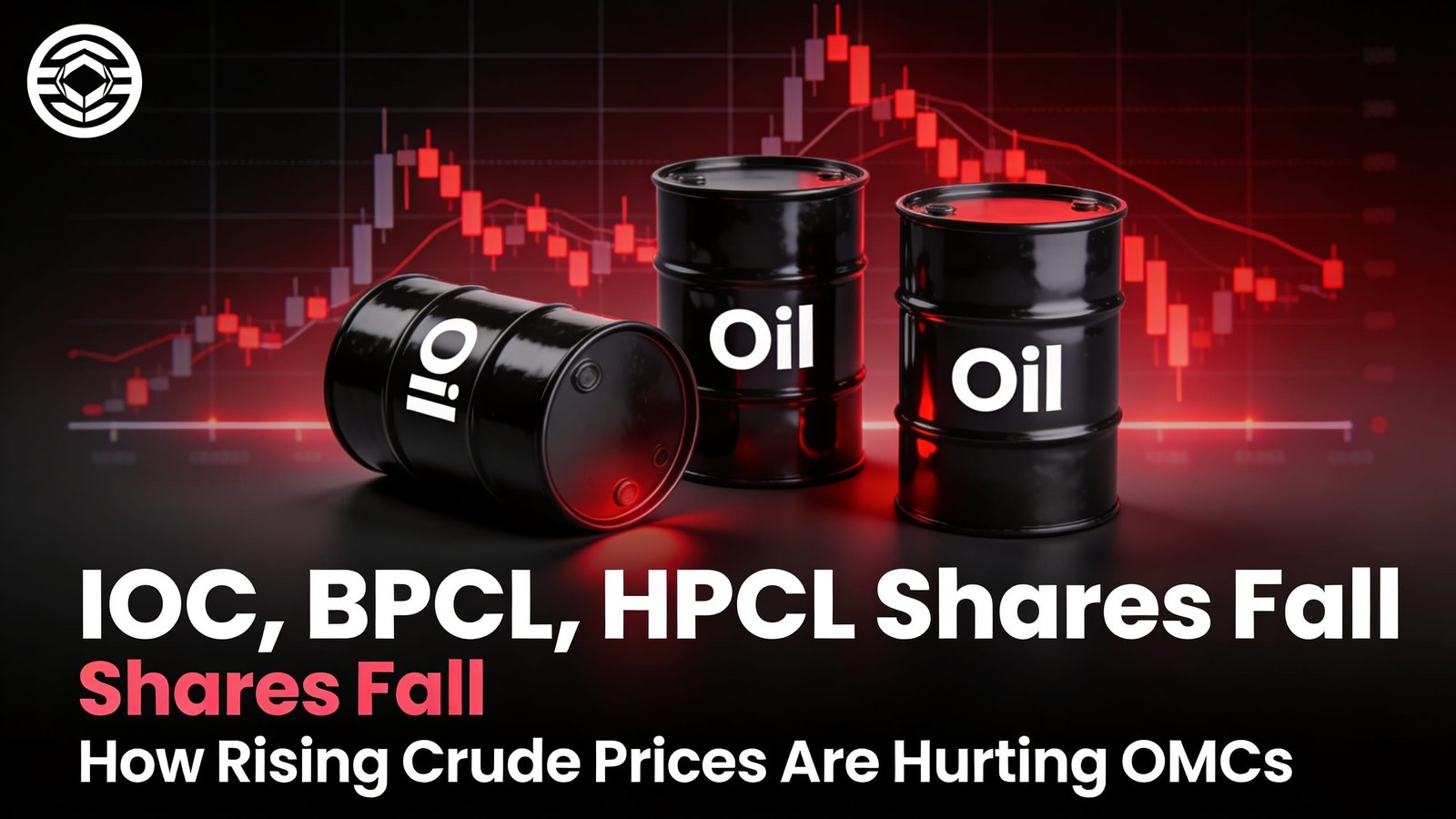
⚠️ IOC, BPCL, and HPCL shares have crashed 25–28% in 2026, and most retail investors still don’t understand the single most dangerous force driving this collapse. It’s not just crude oil prices — it’s a structural trap that could wipe out the entire year’s profit for India’s three largest oil marketing companies (OMCs).
📌 What Is Actually Happening to OMC Stocks?
India’s three state-owned oil marketing companies — Indian Oil Corporation (IOC), Bharat Petroleum Corporation (BPCL), and Hindustan Petroleum Corporation (HPCL) — are caught in a perfect financial storm in 2026. These OMC stocks, which dominate India’s fuel retail, refining, and distribution sector, are experiencing one of their worst stock market performances in recent history.
The core problem is a deadly combination: global crude oil prices have surged sharply, while the Indian government has maintained a strict freeze on retail petrol and diesel prices. For every litre of fuel these companies sell, they are bleeding money. And that bleeding is accelerating by the day.
📊 How Much Have IOC, BPCL, HPCL Shares Fallen?
The scale of the decline in OMC stocks has been staggering. Here’s a quick look at the damage:
To put this into stark perspective, OMC stocks underperformed the Nifty 50 by more than 2.5x during this period. This isn’t a market downturn story — it’s a sector-specific crisis.
| Company | 52-Week High (Approx) | Recent Low (2026) | % Decline | Key Pressure Point |
|---|---|---|---|---|
| BPCL | ₹370–₹380 | ₹262–₹266 | ↓28% | Crude surge + fuel freeze |
| HPCL | ₹444–₹460 | ₹316–₹330 | ↓25–27% | Highest per-litre loss |
| IOC | ₹175–₹180 | ₹130–₹144 | ↓24–27% | Largest LPG under-recovery |
🛢️ Rising Crude Oil: The Engine of OMC Destruction
The most direct driver of pressure on IOC, BPCL, and HPCL share prices is the relentless rise in global crude oil prices. Brent crude surged past $100 per barrel in early 2026, and at one point crossed $112/barrel in March 2026 — driven by escalating geopolitical tensions, particularly the Iran-Israel-US conflict and fears of Strait of Hormuz disruption.
For OMCs, crude oil accounts for 70–80% of total input costs. When Brent crude surges, their procurement cost rises instantly. But the retail price they charge consumers stays locked by government policy — creating an ever-widening gap between cost and revenue. This is the structural vulnerability that makes OMC stocks so sensitive to global oil price movements.
🔒 India’s Fuel Price Freeze — The Silent Killer for OMC Stocks
Here is the factor that turns a crude oil spike from a manageable challenge into an existential threat for OMC stocks: India’s fuel price freeze policy. Since April 2022, the government has kept retail petrol and diesel prices completely frozen to control inflation and protect consumer purchasing power. As of May 2026, petrol is still being sold at approximately ₹94.77 per litre and diesel at ₹87.67 per litre — the same rates as over two years ago.
Meanwhile, due to the 50%+ surge in input crude oil prices, the Ministry of Petroleum and Natural Gas officially acknowledged in April 2026 that OMCs were incurring under-recoveries of ₹24.40 per litre on petrol and ₹104.99 per litre on diesel at retail selling price levels as on April 1, 2026. These are not accounting abstractions — these are real losses being borne by IOC, BPCL, and HPCL on every single litre sold across India.
💸 Under-Recovery Crisis: ₹1 Lakh Crore and Counting
The combined financial damage is now at a scale that is genuinely alarming for investors in IOC BPCL HPCL shares. According to sources cited by Business Today, the three OMCs are incurring under-recoveries of ₹1,600–₹1,700 crore per day, which translates to over ₹1 lakh crore in just 10 weeks.
The Hindu BusinessLine reports that with losses of ₹14/litre on petrol, ₹42/litre on diesel, and ₹674/litre on LPG, the Q1 FY27 losses for OMCs alone could wipe out their entire FY26 profits. That is a catastrophic earnings reset that explains why market sentiment on these stocks has turned so negative.
| Fuel Type | Retail Price (₹/litre) | Under-Recovery (April 2026) | Impact on OMCs |
|---|---|---|---|
| Petrol | ~₹94.77 | ₹14–₹24/litre | Daily retail losses |
| Diesel | ~₹87.67 | ₹42–₹105/litre | Massive P&L erosion |
| LPG (Cooking Gas) | Subsidised | ₹674/cylinder | IOC most exposed |
🏦 Broker Downgrades Are Accelerating the Sell-Off
Weak fundamentals alone would be enough to pressure OMC stocks, but institutional brokerages have amplified the selling. In November 2025, global brokerage Investec downgraded IOC, BPCL, and HPCL to ‘Sell’ from ‘Hold’, citing weakening diesel marketing margins — assigning target prices of ₹330 for BPCL, ₹145 for IOC, and ₹425 for HPCL, all below then-current market prices.
That was followed in March 2026 by Ambit Capital, which also downgraded all three OMCs to ‘Sell’, slashing target prices by up to 57%, arguing that the new normal for oil could settle around $80/barrel — which would still leave marketing margins deeply negative under a price freeze scenario. These institutional downgrades trigger FII and mutual fund selling, creating a cascading effect on IOC BPCL HPCL share prices.
- 📉 Investec (Nov 2025): Downgraded all 3 OMCs to ‘Sell’; focused on diesel margin collapse
- 📉 Ambit Capital (Mar 2026): Slashed targets up to 57%; warned of structural under-recovery
- 📉 JM Financial: Flagged Brent crude likely staying near $65+ through near-term, insufficient for OMC profitability
🏛️ Will the Government Act? What Happens Next for OMC Stocks?
The critical question every investor in IOC, BPCL, and HPCL shares is asking: will the government finally revise fuel prices upward? Signals are beginning to emerge. Outlook Business reports that a fuel price hike may be imminent as OMC losses deepen and the government appears to be signalling a possible revision.
However, with state elections in the pipeline and inflation a politically sensitive issue, the timing of any price revision remains uncertain. The Petroleum Planning & Analysis Cell (PPAC), under the Ministry of Petroleum, continues to publish data showing record crude import volumes, making the case for price correction increasingly compelling from a fiscal sustainability standpoint.
- Government announcement of petrol/diesel price revision (most powerful catalyst)
- Crude oil falling below $80/barrel on geopolitical de-escalation
- Government compensation/subsidy allocation to OMCs in supplementary budget
- Reduction in global oil demand due to macro slowdown
🧠 What Should Investors Do Now?
The OMC stocks under pressure situation is a classic case of government policy risk overriding fundamental business strength. IOC, BPCL, and HPCL are not bad businesses — they have massive infrastructure, distribution networks, and refining capacity. The problem is entirely exogenous: crude oil price behaviour and government pricing decisions.
From a long-term value perspective, BPCL, HPCL, and IOC shares may look attractive at 52-week lows — but only for investors who can absorb further near-term pain. The downside risk remains high as long as the fuel price freeze continues. Any investment in OMC stocks right now is essentially a bet on government policy change, not on business fundamentals.
❓ Frequently Asked Questions (FAQ)
📲 Stay Ahead of Every Market Move!
Join our community for free daily stock insights, OMC updates, IPO alerts, and expert technical analysis — before the market opens.
📚 Authoritative Sources Used
- Ministry of Petroleum and Natural Gas, Government of India — Official under-recovery data
- Petroleum Planning & Analysis Cell (PPAC), GoI — Crude import